

Table of Contents
- How a Wobbly Green Dog and a Smug Pink Cat Became Icons
- Roobarb and Custard Merchandise That Captures the Chaos
- Why Roobarb and Custard Are the Original Punk Cartoon Duo
- The Wobbly Animation Style That Changed Classic British Cartoons
- Nostalgia, Rebellion, and Why These Gifts Still Matter
- Choosing Gifts for Fans of Roobarb and Custard
- Conclusion
- Frequently Asked Questions
Last Updated: September 11, 2026
How a Wobbly Green Dog and a Smug Pink Cat Became Icons
Roobarb and Custard is the 1974 animated series about an over-enthusiastic green dog and a permanently unimpressed pink cat, narrated in rhyming couplets by Richard Briers and drawn in a deliberately shaky style that looked like nothing else on television. At Roobarb and Custard, we have built a shop for the adults who grew up with it and never quite let it go.

The show arrived with a folk-rock theme tune, a hero who never won, and a cat who never lost his composure. It was five minutes long. It was broadcast at teatime. And it rewired what a generation expected from animation.
Below, we look at why the duo still matters, what the merchandise captures, and how to choose a gift that lands properly.
Roobarb and Custard Merchandise That Captures the Chaos
Good merchandise works when it copies the mood of the source, not just the characters. The best Roobarb and Custard merchandise does exactly that: it keeps the wobble, the rivalry and the cheerfulness of a dog who has just built something ridiculous in the garden.
Take the mugs. The Roobarb & Custard Mug puts both characters together, which suits anyone who loved the arguments more than either animal on their own. The Custard Collage Mug is for the cat loyalists, all smug expressions and mischief in one collage. Roobarb fans tend to go for the Roobarb Collage Mug, which leans into the inventions, the skateboards and the flying machines.

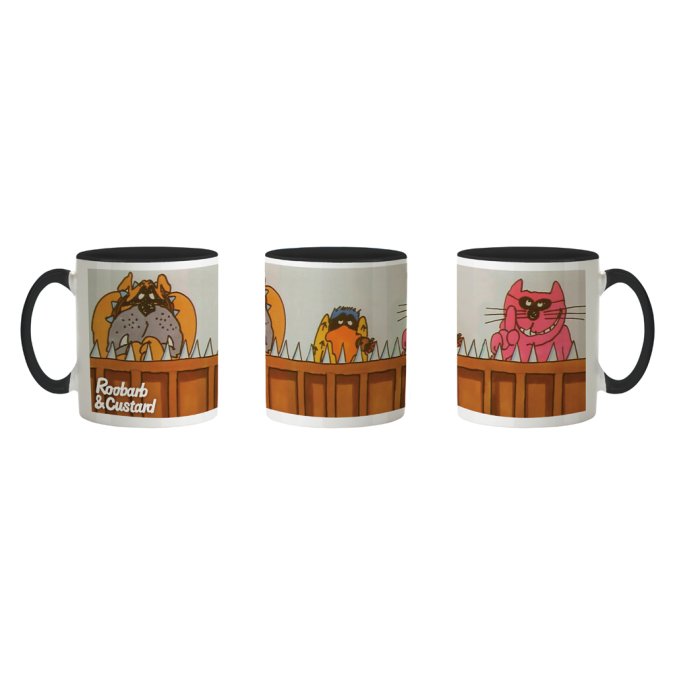
There is a quieter option too. The 'The Birds' Ceramic Mug features the cackling birds, the running gag that anyone who watched the show will recognise instantly and nobody else will understand at all. That is often the best kind of gift.

Why Roobarb and Custard Are the Original Punk Cartoon Duo
Punk, in the sense that matters here, was never really about safety pins. It was about doing something cheap, fast and honest because the polished version had become boring. Roobarb and Custard did that in animation before the word was in common use.
The evidence sits in the production itself. Bob Godfrey's studio drew the characters without outlines, then overlaid a transparent sheet on each frame and re-drew the image slightly out of alignment. The result is a permanent, nervous shimmer, as though the whole programme is vibrating. Traditional animation chased smoothness. This chased energy.
Then there is the casting of the hero. Roobarb loses. Repeatedly. He builds, he schemes, he charges at the problem, and Custard watches from a windowsill with the expression of a cat who has already read the ending. A children's show that let its protagonist fail, week after week, and kept him cheerful about it, was quietly radical.
The Wobbly Animation Style That Changed Classic British Cartoons
The technique is simple to describe and difficult to execute well. Each frame was traced onto transparent sheets, and those sheets were deliberately misaligned before filming. The wobble was not a mistake. It was the entire point.
That decision had consequences. It made the show cheap enough to produce at a time when British studios could not match the budgets of imported animation, and it made the show instantly identifiable in a crowded schedule. Within a few seconds of flicking channels, you knew what you were watching.
It also aged remarkably well. Clean, flat animation from the same decade can look dated now. A drawing that was never trying to be smooth has nothing to lose. The style still reads as intentional, which is more than can be said for a lot of its contemporaries.
Nostalgia, Rebellion, and Why These Gifts Still Matter
Nostalgia gets dismissed as sentimental, and that dismissal misses the point. Reconnecting with something you loved at seven is not retreat. It is a small act of keeping hold of who you were before everything got complicated.
For this audience, the pull is specific. Many people in their forties, fifties and sixties remember the theme tune, the five-minute slot before the evening news, and the particular pleasure of a show that trusted children to enjoy something odd. A mug with a wobbly green dog on it is not really about the mug.
There is a rebellion in it too. Choosing a hand-drawn 1974 cartoon over whatever is currently trending is a quiet statement about taste. It says you know what you like and you are not waiting for permission.
Choosing Gifts for Fans of Roobarb and Custard
The safest gift for a fan is a mug, and the reason is practical rather than sentimental. It gets used every day, it sits in a kitchen where visitors can see it, and it starts conversations. For someone who watched the show as a child, that daily reminder is worth more than an ornament that goes on a shelf and stays there.
A simple way to choose:
| If the recipient... | Choose | Why it works |
|---|---|---|
| Loved the arguments most | The duo mug | Both characters, one design |
| Was always a cat person | Custard Collage | Maximum smugness |
| Was always a dog person | Roobarb Collage | Inventions and energy |
| Quotes the running jokes | 'The Birds' mug | In-joke recognition |
| Barely remembers the show | The duo mug | Easiest to recognise |
Two things are worth knowing before you buy. First, "official" means licensed, so check that a product is branded as such rather than trusting a marketplace listing at face value. Second, if the gift is for someone else, a mug travels well and arrives intact far more reliably than anything ceramic and fragile.
Conclusion
Finding a gift that means something to someone who grew up with a five-minute cartoon about a dog who never won is harder than it sounds, and most generic retro merchandise misses the point entirely.
Roobarb and Custard exists for exactly this. Our range covers official homeware and kitchenware featuring the characters fans actually remember, from the duo mug to the Custard Collage and the 'The Birds' design, all produced to the standard the show deserves. Get started with Roobarb and Custard and give a gift that lands the moment it comes out of the box.
Frequently Asked Questions
Who created the original Roobarb and Custard series?
Roobarb and Custard was created by Grange Calveley, who wrote the scripts, and animated by Bob Godfrey, a legendary figure in British animation. It first aired on BBC1 in 1974. The show followed the rivalry between Roobarb, an enthusiastic green dog, and Custard, a smug pink cat. Its distinctive wobbly animation style and witty narration by Richard Briers made it an instant favourite with children and adults alike.
Why is Roobarb considered a punk animation classic?
Roobarb and Custard arrived in 1974, just as punk was gathering momentum. Its rough, hand-drawn look and chaotic energy felt like a rejection of the polished Disney style. The characters were rebellious, the humour was dry and surreal, and the show refused to talk down to its audience. That DIY spirit and anti-establishment attitude is exactly why many fans now call Roobarb and Custard the original punk cartoon duo.
Where can I find authentic Roobarb and Custard merchandise?
Authentic Roobarb and Custard merchandise is available directly from the official online shop. Look for the official branding and character artwork that matches the original 1974 series. The range includes ceramic mugs, apparel, and homeware featuring Roobarb, Custard, and other characters. Buying from the official source ensures you receive properly licensed items rather than cheap knock-offs. Each piece is designed to celebrate the show's wobbly, nostalgic charm.
What makes the animation style of Roobarb so unique?
Roobarb and Custard used a technique where each frame was drawn by hand and then photographed, creating a deliberately shaky, wobbly effect. This was partly a practical choice, but it became the show's signature. The characters and backgrounds moved in a jittery, lively way that matched the chaotic energy of the stories. It stood out against smoother, more polished cartoons of the era and helped define the look of classic British cartoons from the 1970s.