

Table of Contents
- The Wobbly Line That Time Couldn't Erase
- How the History of British Stop-Motion Animation Shaped the Decade
- The Classic British Cartoons of the 70s That Still Define Teatime
- Why the Animation Style Still Feels Distinctive Today
- Collecting Vintage British Animation Merchandise Without Getting Burnt
- Bringing the Wobble Home: Prints, Apparel and Everyday Pieces
- Conclusion
- Frequently Asked Questions
Last Updated: September 30, 2026
The Wobbly Line That Time Couldn't Erase
1970s British animation occupies a strange position in popular culture. It was made quickly, on tight budgets, often by small studios working with marker pens and whatever film stock they could get. And yet, half a century later, it still looks and feels like nothing else. This guide from Roobarb and Custard looks at why that era of animation holds up so well, what made its visual language so distinctive, and how fans can bring a piece of it into their homes today.
The answer isn't nostalgia alone.
The decade's defining trait was imperfection used on purpose. Where bigger studios chased smooth, polished movement, British animators leaned into wobble, visible linework and hand-drawn energy. That choice turned limitation into identity, and it's why so many of these characters still feel alive.
Below, we'll break down the history behind that style, the shows that defined teatime, and what to check before buying memorabilia online.
How the History of British Stop-Motion Animation Shaped the Decade
The history of British stop-motion animation reaches back further than most fans realise, and its influence ran straight through the 1970s. Small studios built on frame-by-frame craft, physical models and hand-painted cels, and that groundwork shaped how the decade's cartoons moved and looked.
Where stop-motion demanded patience and precision, the marker-pen animation of the 70s went the other way: loose, fast and deliberately rough. Both approaches shared a workshop mentality. Animators worked close to the drawing board, and the results carried the fingerprints of the people who made them.
That workshop feel is a big part of why the era's output still reads as handmade rather than manufactured. It's also why collectors today prize items that show the actual production process, such as original animator notes and character style sheets, rather than just a finished logo slapped on a mug.
The Classic British Cartoons of the 70s That Still Define Teatime
Ask anyone who grew up in the 70s or 80s what teatime telly meant, and you'll get the same answer: a frantic theme tune, a wobbly character, and five minutes of glorious chaos before dinner. The classic British cartoons of the 70s built that ritual.
Roobarb and Custard is the clearest example. A green dog with boundless optimism and a smug pink cat next door, drawn in a deliberately shaky hand, it captured something very British: grand plans, inevitable failure, and a laugh about it. The show's creator, Grange Calveley, and animator Bob Godfrey built its charm on that imperfection rather than in spite of it.
Other teatime favourites of the period followed similar rules. Short episodes, strong characters, and animation that trusted the writing over technical polish. That formula is why these shows survived repeated scheduling changes and still get quoted decades later.
Why the Animation Style Still Feels Distinctive Today
The style still stands out because modern animation has moved in the opposite direction. Today's output is smoother, higher-resolution and far more consistent. The 1970s wobble looks like a signature because nothing else on screen moves quite like it.
Three things drive that distinctiveness:
- Visible linework. You can see the pen strokes, and that shows the human hand behind every frame.
- Elastic movement. Characters stretch, squash and jitter in ways that read as energetic rather than sloppy.
- Limited colour. A bold single colour against monochrome sketches makes the character instantly recognisable.
The BFI's national archive collection preserves much of this era's television output, which matters because the style is as much a historical record as an artistic one. When a design leans on the original sketches rather than a redrawn version, it keeps that record intact.
Collecting Vintage British Animation Merchandise Without Getting Burnt
Collecting vintage British animation merchandise is where enthusiasm most often runs ahead of caution. The market is full of items described as official that turn out to be unlicensed reprints, and the difference shows up fast once the parcel arrives.
Roobarb 'Colour Pop' Limited Edition →
The safest approach is to buy from a seller who can tell you exactly what a product is made from, where it was printed and how it's licensed. Vague listings are the biggest warning sign.
Here's a quick checklist before you buy:
- Does the listing name the licence or rights holder explicitly?
- Is the material and finish specified (paper weight, fabric type, print method)?
- Are dimensions given in centimetres, not just "large"?
- Does the seller state where the item is printed or manufactured?
- Is there a clear returns process if the item arrives damaged?
- Do the product photos show the actual item, not a mock-up?
| Risk | What It Looks Like | How to Avoid It |
|---|---|---|
| Unlicensed reprint | Cheap paper, blurry linework | Ask for the licence and paper weight |
| Wrong material | Thin fabric that fades fast | Check the stated fabric and wash guidance |
| Poor packaging | Print arrives creased or bent | Confirm mounting or framing is included |
| No returns route | Seller goes quiet after payment | Buy where returns are documented |
Bringing the Wobble Home: Prints, Apparel and Everyday Pieces
Bringing the era into your home works best when you pick pieces that respect the original artwork. Official merchandise from Roobarb and Custard is built around genuine behind-the-scenes material, which is what separates a collectable from a novelty.
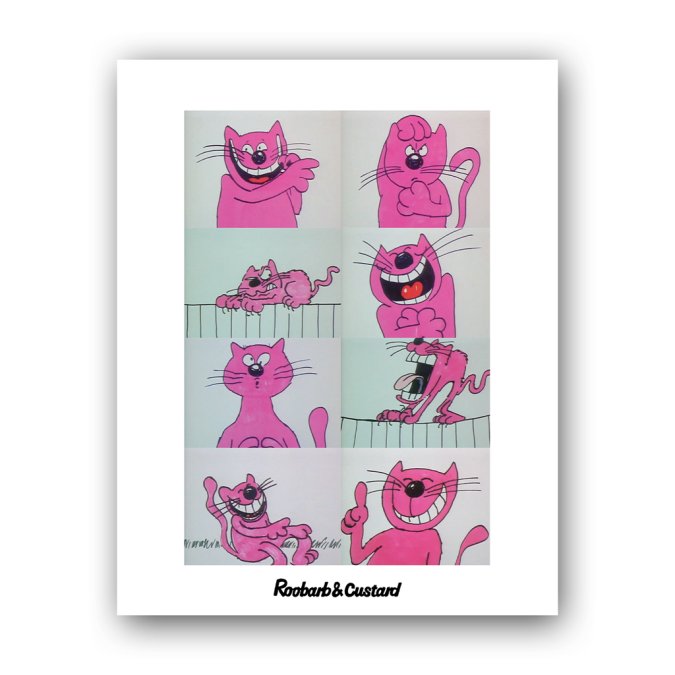
For wall art, the Roobarb 'Colour Pop' Limited Edition Mounted Print at £75.00 is a strong starting point. It's printed on 280gsm satin white media, mounted on off-white board, and limited to 100 prints worldwide. The Custard 'Colour Pop' Limited Edition Mounted Print at £75.00 mirrors it for fans of the cat.

If you'd rather spend less, the Roobarb Collage and Custard Collage art prints at £9.99 each use the same 280gsm stock and can be bought framed or unframed.
For wearable pieces, the animator notes range is hard to beat:
| Product | Price | Material | Best For |
|---|---|---|---|
| Roobarb Style Sheet T-Shirt | £19.99 | 100% organic cotton | Everyday wear |
| Custard Style Sheet Sweatshirt | £29.99 | 100% organic cotton | Colder months |
| Roobarb Grid Storyboard Hoodie | £49.99 | 350gsm organic cotton | Layering |
| Director's Clapperboard Coaster | £4.99 | Cork-backed, 10cm x 10cm | Small gifts |
| Roobarb Sketch Pattern Tote | £17.99 | 100% cotton, 40cm x 40cm | Daily use |
Conclusion
The hardest part of collecting this era isn't finding merchandise. It's finding pieces that stay faithful to the original artwork instead of flattening it into a generic retro logo. That's the difference between something you display proudly and something you quietly relegate to a drawer.
Roobarb and Custard exists to close that gap. Every item is official merchandise, built around genuine animator notes and character sketches, and printed in the UK on materials that hold their colour. The range covers apparel, homeware and kitchenware, so there's a piece for every budget, from a £4.99 coaster to a £75.00 limited edition print.
Get started with Roobarb and Custard and bring a properly authentic slice of 1970s animation into your home.
Frequently Asked Questions
What made 1970s British animation unique compared to other eras?
The decade ran on hand-drawn craft and small studio teams rather than factory-line production. Bob Godfrey's studio, for example, built Roobarb & Custard around deliberately wobbly marker-pen linework that moved and shifted frame to frame. That looseness was a style choice, not a shortcut. Combined with tight budgets, it produced cartoons with visible personality: shaky outlines, bold colour pops and character designs that felt sketched rather than polished. That handmade quality is exactly why 1970s British animation remains iconic while slicker later series have faded from memory.
Are 1970s British cartoons still popular with modern audiences?
Yes, and the appetite shows no sign of slowing. Adults who grew up with these shows now seek out officially licensed merchandise, while parents introduce the characters to their own children. Officially licensed ranges cover apparel, homeware and limited-edition art prints, such as the Roobarb 'Colour Pop' mounted print at 40x50cm for £75, restricted to 100 prints. That mix of childhood nostalgia and genuine design quality keeps the 1970s era relevant well beyond its original broadcast dates.
What role did stop-motion play in 1970s British animation?
Stop-motion sat alongside hand-drawn work as one of the era's defining techniques. Small teams built physical models, puppets and cut-out characters, then photographed them frame by frame, which gave movement a tactile, slightly imperfect quality that computer animation struggles to copy. The history of British stop-motion animation runs through this period as a high point of craft, and it shaped audience expectations: viewers learned to watch for texture, weight and small human errors in the motion, not just the story.
How do I know retro animation merchandise is officially licensed?
Check for official licensing statements, brand-owned storefronts and accurate character names and artwork. Genuine pieces usually describe production details: for instance, Roobarb & Custard apparel is printed in the UK on 100% organic cotton, and the limited-edition prints are produced on 280gsm satin white media in runs of 100. Vague listings with no licence information, suspiciously low prices and stolen or redrawn artwork are the usual warning signs. Buying directly from the brand's own shop removes most of that risk.